
Why SR&ED bridge financing is so hard to get right in Canada
Why SR&ED lenders keep leaving the market, what to do if yours stopped funding, and how to tell if the next one will still be there.
Since mid-July, about 20 Canadian founders have called me with the same story. Another lender approved them for SR&ED bridge financing, then couldn't fund, and payroll was still due.
It isn't the first time this has happened. I've been financing SR&ED claims for more than 15 years, and I've watched a long line of lenders arrive, grow quickly and quietly stop. This letter is for founders and CFOs who count on their SR&ED refund to cover payroll. It covers why lenders keep disappearing, what to do if yours has, and how to tell whether the next one will still be around for your next draw. (If you're new to all of this, start with our guide to SR&ED financing.)
The short answer SR&ED bridge financing is a loan secured by a company's expected refundable SR&ED tax credit and repaid when CRA pays the refund. It's hard to do well because the collateral is a tax claim CRA can reduce at any time, the loans are short, and many lenders are paid for placing loans rather than collecting them. The lenders that last judge the claim itself, watch the borrower closely and turn down a lot of files.
Why do SR&ED lenders keep leaving the market?
The risks are hard to measure, and the incentives often push the wrong way. Almost every exit I've seen traces back to four things.
The people placing loans aren't paid to collect them. Many lending funds reward the manager (the general partner, or GP) for getting money out the door. To grow the book, the lender takes on riskier loans or does less diligence. That works until the bad loans show up together. In a pooled fund, one bad loan hurts every investor, and before long the investors walk.
They can't judge the claim. The SR&ED claim is the collateral, and CRA can review it and reduce it at any time. A lender that can't tell a strong claim from a weak one is playing Russian roulette with CRA.
They stop watching once the money is out. SR&ED loans are short, so monitoring feels like overhead. Skip it and you get surprises instead of early conversations.
The economics punish chasing volume. In my experience, the average SR&ED loan is outstanding for about six months, and only 30% to 50% of borrowers come back the following year. To keep a $20M book fully deployed, a lender has to write roughly $40M of loans a year, mostly to new clients. That's expensive, and the easy fix is to lower the bar. The only sustainable way through is to say no a lot.
Why is the claim the hardest part to underwrite?
Because a claim can look clean on paper and still fall apart in a CRA review, and the loan doesn't shrink when the refund does.
The most common mistake I see is a lender noting that CRA accepted the company's last three claims and assuming the next one is safe. That only means something if CRA actually reviewed those claims. A claim that was accepted without a review tells you very little.
So we read the technical descriptions, not just the totals. We check that the claim lines up with the rest of the tax return and the financial statements. We look for jargon and padding that add words but not substance. We look at how much of the payroll is being claimed: a claim covering most of a company's salaries can be justified, but it deserves a hard look. Claiming close to 100% of labour is also one of the common triggers for a CRA review, according to our sister SR&ED consulting firm, GrowWise.
We also check who really prepared the claim. A big accounting firm's name on the claim is reassuring until you see the fee. If the fee is far too low for a full preparation, the firm most likely reviewed a claim written in-house, and nobody can say how deep that review went.
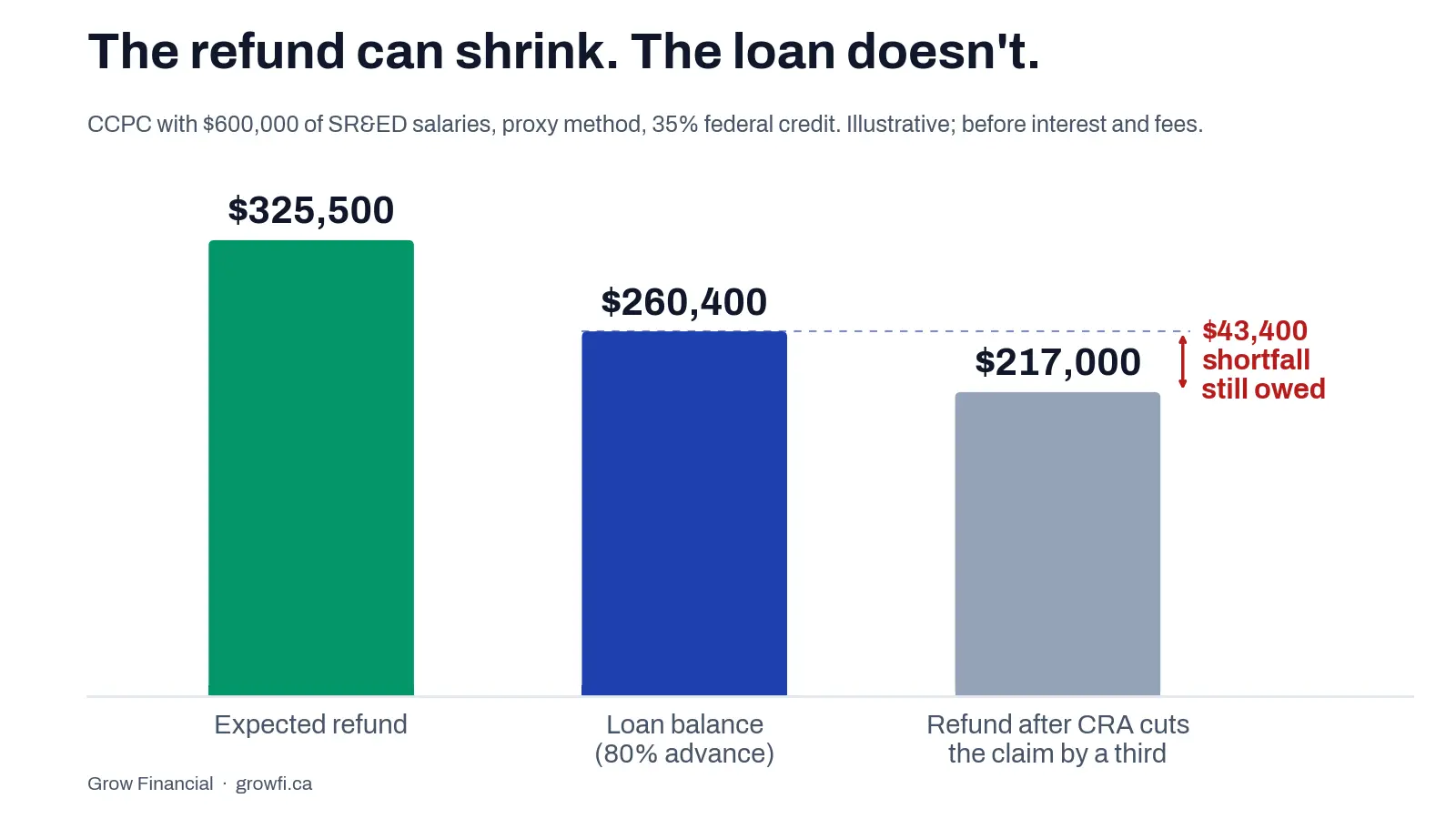
Here's why this matters in dollars. A CCPC (Canadian-controlled private corporation) spending $600,000 on SR&ED salaries under the proxy method has $930,000 of qualified expenditures: the $600,000 plus the 55% overhead proxy. At the 35% enhanced rate (2026 rules), that's a federal refundable credit of about $325,500. If CRA cuts that claim by a third, the refund drops by more than $100,000. The loan doesn't drop at all: on an 80% advance, you'd still owe about $43,400 more than the refund covers, before interest and fees. That's why we typically advance 70% to 100% of the expected refundable credit and not more, and why the claim comes first in everything we do.
How is Grow Financial built differently?
We're set up so the only way we do well is if your loan gets repaid.
Our incentives are aligned with our investors'. Our management fee doesn't cover the cost of running the business. Grow Financial earns its real return only after our investors have earned theirs, so a bad loan costs us directly.
We underwrite the claim first. Every file gets the review described above before we talk about how much we can advance. We also get access to your CRA account before we fund.
We monitor actively. Borrowers send us an income statement, a balance sheet and a compliance certificate (a short signed confirmation that nothing material has changed), plus answers to a few questions, such as whether there's new litigation or changes on the executive team. We look for trends and anything unusual. When something looks off, we pick up the phone. Most problems can be solved if everyone talks early.
We say no about half the time. The most common reasons are too much existing debt, a company that needs a lifeline rather than a bridge, a claim we don't believe will hold up in a review, and concerns about the track record of the people running it. Turning down files is how we stay around to fund the ones we approve.
Our capital is Canadian, and so is our track record. Across my career, including as a Partner at Espresso Capital and as founder of Venbridge, I've funded well over $100M to hundreds of companies. In all those years, I've never had to tell an approved borrower we couldn't fund due to lack of capital.
My SR&ED lender stopped funding. What now?
Talk to another lender before your next draw is due, and expect full underwriting again.
Switching to us works the same way as any new application. We'll ask for financial statements, bank statements, tax returns, notices of assessment and access to your CRA account. If another SR&ED lender has already approved you, there's a good chance we will too, though every file is reviewed on its own merits. Your old lender discharges its security registration. If you've already taken draws and the old lender can't fund the rest, we can generally pay out the existing loan and continue with quarterly draws as your SR&ED accrues.
Our underwriting system is built to move quickly. In most cases, the whole process from first call to money in the bank takes five to ten business days, subject to approval and a complete set of documents.
Who shouldn't call me?
Some situations are a firm no, and I'd rather say so here than on a call.
- You're in default with an existing lender.
- Your expected refundable SR&ED credit is under $100,000.
- You've never filed an SR&ED claim. The exception is a spin-out where the same team has been filing for years under another company.
- You're out of money, and the SR&ED loan is the only thing keeping the company open. We lend to extend runway alongside equity, not to be the last money in.
For everyone else, remember that this is a loan. Interest accrues monthly and is paid from the refund, plus standard setup and disbursement fees. If CRA reduces your claim, you still owe the full balance, and we'll work with you to repay the shortfall from cash flow, future SR&ED claims or another arrangement. If you can wait for the refund without hurting the business, wait.
The takeaway
If your lender has gone quiet, gather your financial statements, tax returns, and CRA access now. It turns a switch that could take weeks into one that takes days. And when you choose the next lender, ask how they judge the claim before you ask how much they'll advance. The answer tells you whether they'll still be around next year. For how the main lenders compare on terms, see SR&ED lenders in Canada compared.
Not sure if you qualify, or how much you could borrow? Send me your numbers and I'll give you a straight answer. Book 30 minutes
Frequently Asked Questions
Are SR&ED lenders in Canada still funding in 2026?
Some are, and some have stopped or slowed new advances this year. Before you sign, ask any lender where its capital comes from, how long it has been funding, and what happens to your remaining draws if its funding changes.
Can I switch SR&ED lenders partway through the year?
Generally, yes. The new lender underwrites you from scratch, the old lender discharges its security, and any balance outstanding is usually paid out from the new facility. Your claim stays the same. The only thing that changes is who you owe.
What should I ask an SR&ED lender before signing?
Ask who reviews the claim and how, how the fund manager is paid, how often they decline files, and how they've handled borrowers whose claims CRA reduced. Vague answers tell you what you need to know.
What happens if CRA reduces my claim after I borrow?
The loan stays the same size. You repay the shortfall from cash flow, future SR&ED claims or another arrangement agreed with the lender. CRA explains its review process on its After you claim page, and our post on what happens to your SR&ED loan if CRA reduces your claim covers the repayment side.
Related articles
Related pages

Garron Helman - CEO
Garron Helman is the founder of Grow Financial, a Canadian lender providing SR&ED financing to innovative businesses. With over 15 years of experience in financing Canadian companies, including as a Partner at Espresso Capital and founder of Venbridge, Garron understands the challenges of funding growth. He writes about SR&ED, non-dilutive financing, and helping founders access capital without giving up equity.
This article is for general information only and isn't tax, legal or financial advice. SR&ED eligibility is determined by the Canada Revenue Agency. All financing is subject to Grow Financial's credit approval and loan documentation. Speak with a qualified adviser about your situation.