
Can you borrow against SR&ED before you file?
Canadian tech companies can borrow against SR&ED credit earned this year, before filing. Grow Financial advances 70% to 100% of expected refundable credits (minimum $100,000), drawing quarterly from $25,000. Loans are based on accrued SR&ED, repaid from the CRA refund, and best used when you genuinely need cash, not as an equity substitute.
 Garron Helman
Yes. In Canada you can borrow against SR&ED while the work is still happening, months before your claim is filed. About 90% of what Grow Financial lends is against accrued SR&ED: work you've already done this year that hasn't been claimed yet.
Most founders I talk to assume they have to file their corporate tax return first. That assumption costs them time they often don't have. This post is for founders and CEOs of Canadian tech companies who expect a refundable SR&ED credit and want to know how early the money can arrive. For the bigger picture, see our guide to SR&ED financing in Canada.
The short answer: You don't need to wait until you file. If your company is a CCPC expecting a refundable SR&ED credit of at least $100,000 and you're already paying salaries or contractors, you can typically borrow against the SR&ED you've accrued so far, drawing quarterly as it grows. The loan is repaid from your CRA refund.
What is accrued SR&ED financing?
Accrued SR&ED financing is a loan secured by the Scientific Research and Experimental Development (SR&ED) credit your company has earned so far this year but hasn't claimed yet. The work is done and the salaries are paid. Only the paperwork is still to come.
That's the opposite of how most founders picture it. The usual assumption: finish the year, file the T2 and the T661 (the SR&ED claim form), then wait for CRA. As of 2026, CRA generally aims to process a refundable claim within 60 days if it isn't reviewed and 180 days if it is (CRA: After you claim). Add it up, and cash from January's work can land well over a year later.
My view is simple. The best time to ask for an SR&ED loan is when you need the money, or just before. There's no reason to wait for your year-end or your filing, because the need for operating cash very rarely lines up with either.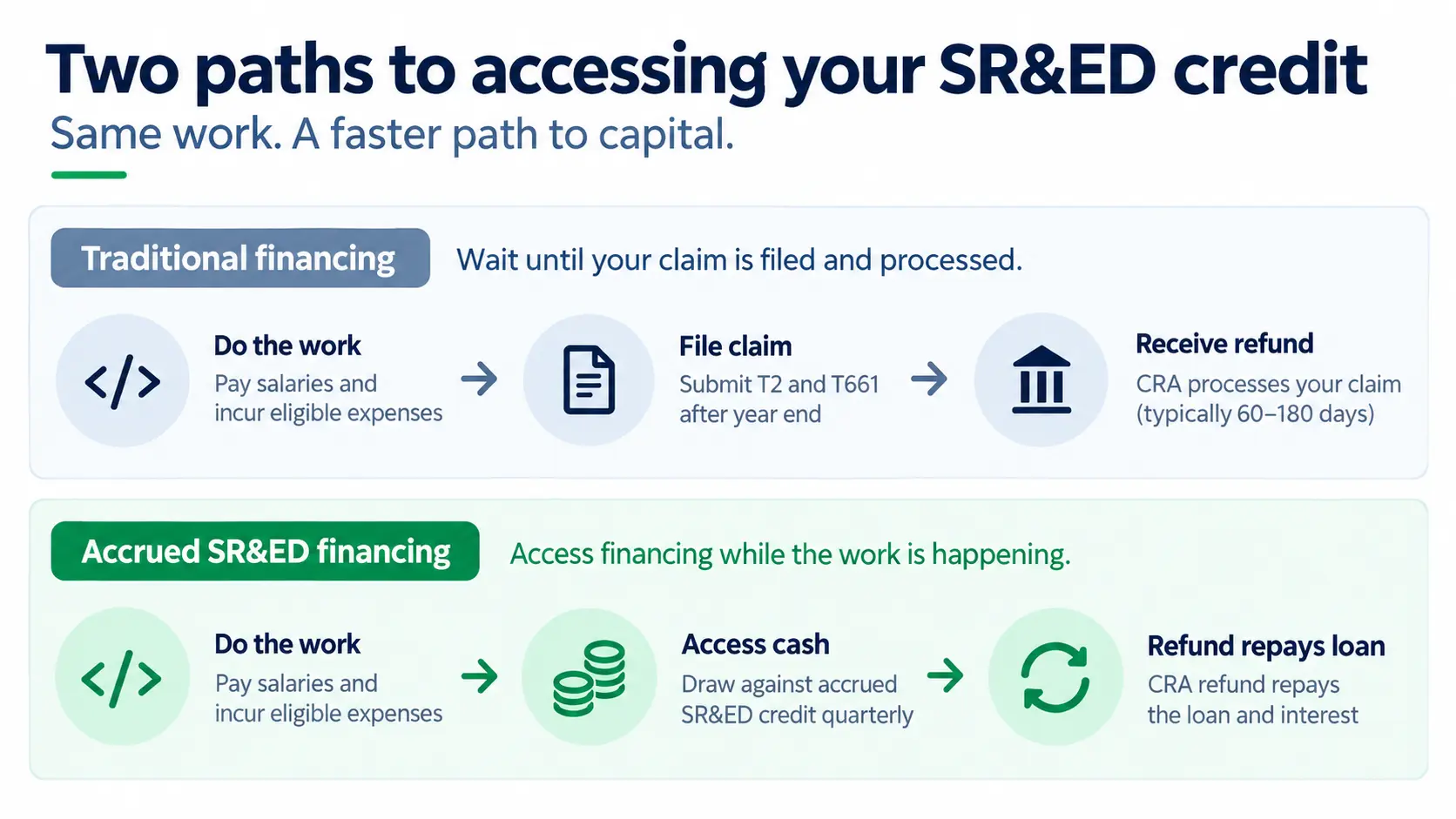
How early in the year can you borrow against SR&ED?
As soon as you've accrued enough to make a draw. What matters is how much SR&ED you've built up. Our minimum draw is $25,000. At a 75% advance, that takes about $33,000 of accrued credit, or roughly $60,000 of SR&ED salaries under the proxy method. Most qualifying companies get there in their first quarter.
We fund quarterly as the credit accrues. Each draw needs three documents: an income statement, a balance sheet and a compliance certificate, which is a short signed confirmation that nothing material has changed and you're meeting the loan's conditions.
In practice, founders rarely plan this in advance. They hear about it from a board member, a peer or someone at a conference, and they call when something specific comes up. A customer pays late and payroll is getting tight. A raise is taking longer than planned. Or they want a bigger cash balance going into a raise so they aren't negotiating from a weak spot.
One recent example: an established Atlantic Canadian software company with a development team of four or five, selling in Canada and abroad. They wanted to expand internationally and didn't want to spend months raising equity to do it. Their year end is December 31 and they file close to the six-month T2 deadline in June. They drew in April, against SR&ED they'd already earned but hadn't claimed. When their 2025 refund arrives and repays the loan, they can start drawing against the 2026 credit that's been accruing all year.
How is accrued SR&ED sized before the claim is prepared?
We estimate it from payroll, anchored to your last filed claim. For most software companies, T4 salaries make up the bulk of the claim, so the refund tracks payroll closely.
The rough version is headcount: how many engineers you have this year against last year. The better version is your payroll register, this year against last. We take last year's claim, scale it by the change in payroll and project the full year. Then we ask what's different. A new or unusually technical project can raise the share of salaries that qualify, and we want to know about it. If your claim is driven by contractors, materials or capital instead, we work from those expenses directly.
A worked example. Say you're a CCPC paying $600,000 a year in SR&ED salaries and using the proxy method, which adds 55% for overhead. Your qualified expenditures are $930,000. At the 35% enhanced federal rate that applies for tax years beginning on or after December 16, 2024, that's a refundable credit of about $325,500 for the year, before provincial credits (SRJ CPA guide).
By the end of your first quarter you've paid about $150,000 of those salaries, or roughly $81,000 of accrued credit. At a 75% advance, you could draw about $61,000, then more each quarter as the credit builds. Advances generally range from 70% to 100% of the expected refundable credit. A good filing history, healthy runway and a lower-risk claim sit at the top of that range.
One caution: the estimate has to be honest. A claim stretched to borrow more just means a bigger loan and a harder conversation when CRA reviews it.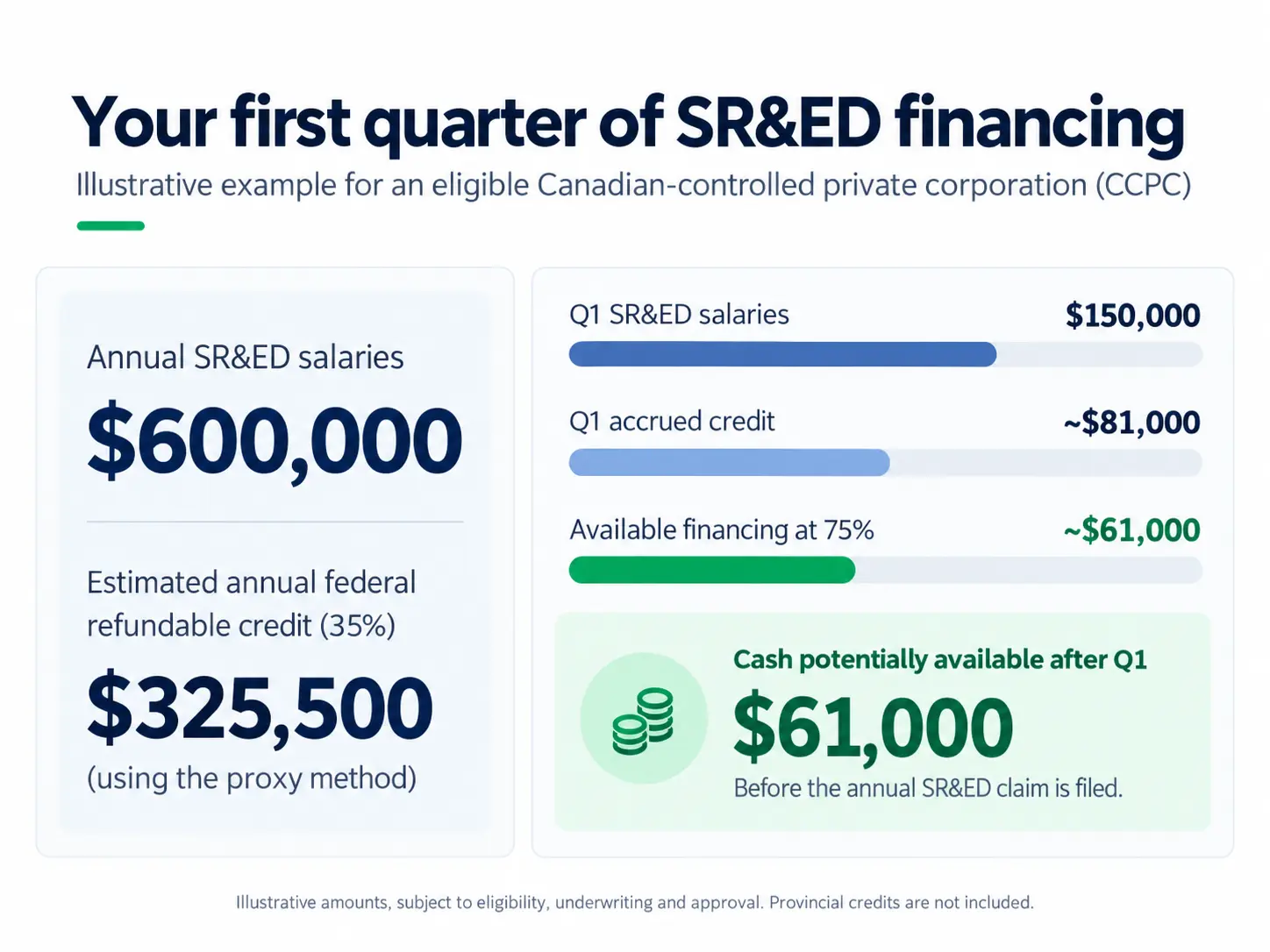
What does a lender check before funding accrued SR&ED?
Consistency. Founders expect us to look at the claim. What they don't expect is how much time we spend making sure every source tells the same story.
Before we disburse, we get access to your CRA account. We look at your bank statements, financial statements and tax returns, your revenue and expense trends, the leadership team's track record, how much of total labour is claimed as SR&ED, and the split between employees and contractors. Then we reconcile all of it. If payroll in the bank doesn't match payroll in the financials, or the SR&ED share of labour looks out of line with the work, that's the first conversation we have.
We also look at where we'd sit in your debt stack. We take first priority on the SR&ED claim and file a general security agreement behind your senior lender. If you have a bank, we sign an intercreditor agreement with them so everyone knows who gets paid from what. That can take a little time, but banks are usually glad to see more cash going into the company.
Why lend before the claim is filed?
Because that's when the money is useful. Some banks and lenders will only finance a filed claim, since by then they know its exact size. The catch is timing: by the time a claim is filed, the moment that needed the cash has often passed.
Lending on accrued SR&ED carries more risk, and I won't pretend otherwise. The final claim can come in a little higher or lower than forecast. We manage that with the company's claim history, how it's been financed to date, its revenue and expense trends, its contingency plans and a working relationship through the year. After more than 15 years of doing this, the estimate is rarely far off. It's also why most advances sit below 100% of the expected credit: the gap is a cushion against CRA adjustments.
What happens when the claim is filed?
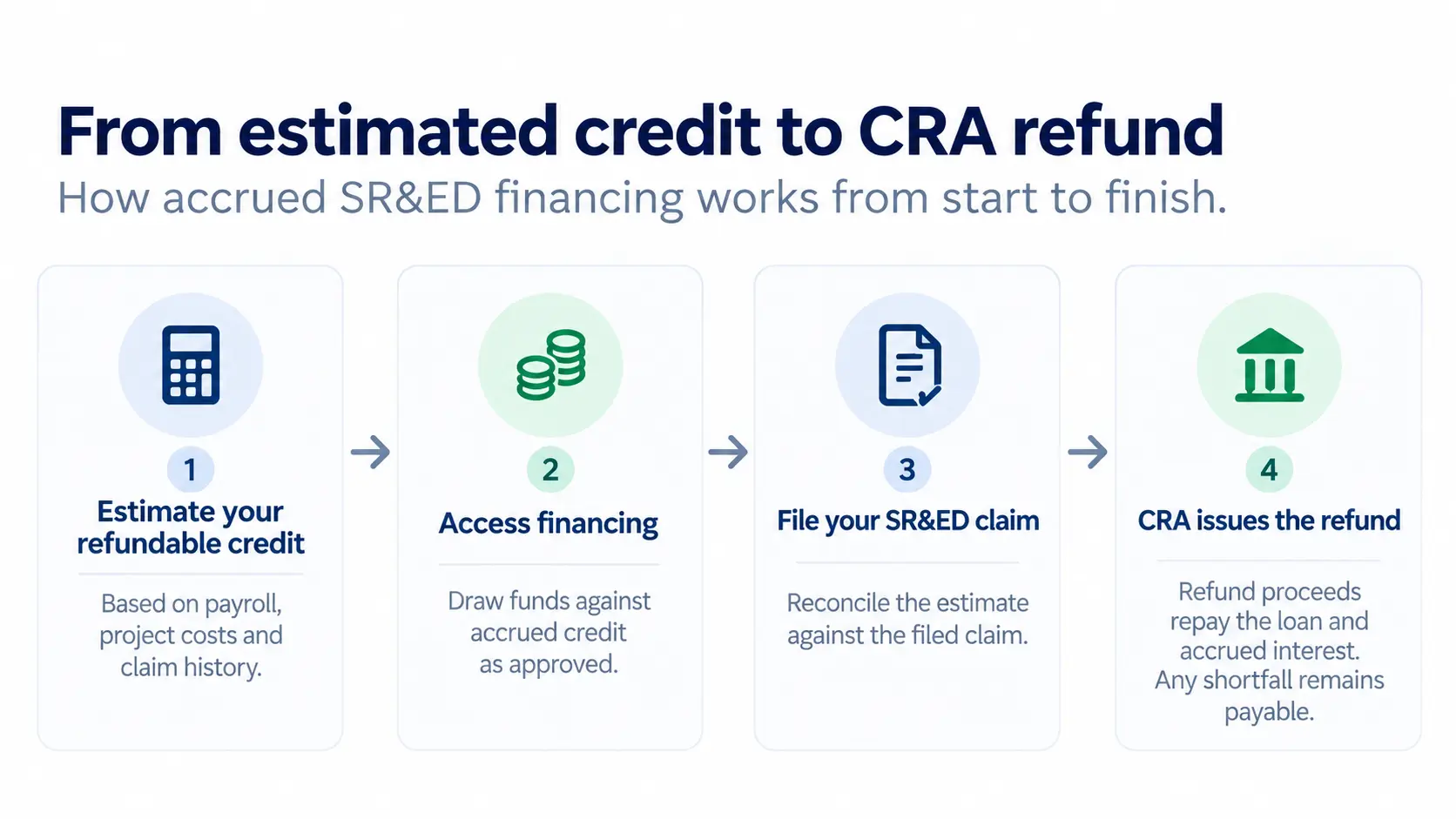
If it comes in lower than what's been advanced, the loan doesn't shrink with it. We watch the refund, and if it doesn't cover principal and interest, we work out a plan with you: repaying from cash flow, from a future SR&ED claim or by other means, depending on where the business is. The same applies if CRA reduces the claim after a review. It's a loan, and it's still owed. [What happens to your SR&ED loan if CRA reduces your claim](LINK: post 1.6 when live) covers that in detail.
Cost works the same way from start to finish. Interest accrues monthly on what you've drawn and is paid from the refund, so there are no monthly payments by default. There are also standard setup and disbursement fees. Pricing is competitive with the market, and you'll see every cost before you sign.
When shouldn't you borrow against accrued SR&ED?
When you don't need the money. If the refund can arrive on its own schedule without hurting the business, there's no reason to pay interest on cash you won't use. Some founders borrow anyway because a bigger bank balance lets them sleep at night. That's a fair choice, as long as it's a deliberate one.
It's also the wrong tool if what you need is equity. I'd much rather complement an equity raise than replace one. A refund advance buys time; it doesn't fix a business model. If you're weighing the two, [how fast you can get money from debt versus equity](LINK: post 2.3 when live) is worth a read.
And some companies won't qualify. First-time claimants generally don't, unless the team has filed SR&ED at a previous company. Neither do companies with a very short runway, a poor credit history, or no salaries or contractors yet. We're also careful with claims that weren't prepared by a qualified SR&ED preparer, because we need to know the claim will hold up under review.
The takeaway
If you expect a refundable SR&ED credit and a specific cash need is coming, start the conversation before it arrives. You'll draw on your schedule instead of the CRA's.
Not sure if you qualify, or how much you could borrow? Send me your numbers and I'll give you a straight answer. Book 30 minutes
Frequently Asked Questions
How much can I borrow against accrued SR&ED?
Advances generally range from 70% to 100% of your expected refundable credit, with facilities up to $1.5M. You need an expected refundable credit of at least $100,000. Where you land in the range depends on your filing history, runway and the overall risk of the claim.
How fast can I get my first draw?
We aim to fund within 2 to 5 business days once your documents are complete, subject to approval. If you have a bank, the intercreditor agreement can add some time. We don't ask for much, because the asset we're lending against is the SR&ED claim itself.
What do I need to apply?
An income statement and balance sheet covering the last 12 months, bank statements and tax returns for verification, and information about the SR&ED claim so we can judge its quality. We'll also ask for access to your CRA account. [What to prepare before applying for SR&ED financing](LINK: post 1.2 when live) has the full list.
Can I borrow against SR&ED every year?
Typically, yes. Once one year's refund arrives and repays the loan, you can start drawing against the next year's credit as it accrues. Each facility has a maximum term of 12 months.
Do I need a personal guarantee?
Generally not, though smaller loans may need one.
Related articles
Can I get an SR&ED loan if my bank has me in special loans?
A strong SR&ED claim was declined because the bank had the company in special loans. Why that usually ends it, and what to do instead.
Can I get an SR&ED loan if we prepared our claim in-house?
An aggressive, in-house SR&ED claim was declined because we couldn't rely on it to survive a CRA review. Why lenders won't dig, and what to do instead.
SR&ED Financing Explained: How to Turn Your Future Tax Credits into Immediate Cash Flow
Building innovative companies in Canada is expensive, and SR&ED refunds often take months to arrive, creating a painful cash flow gap. SR&ED financing solves th
Related pages
Garron Helman - CEO
Garron Helman is the founder of Grow Financial, a Canadian lender providing SR&ED financing to innovative businesses. With over 15 years of experience in financing Canadian companies, including as a Partner at Espresso Capital and founder of Venbridge, Garron understands the challenges of funding growth. He writes about SR&ED, non-dilutive financing, and helping founders access capital without giving up equity.